


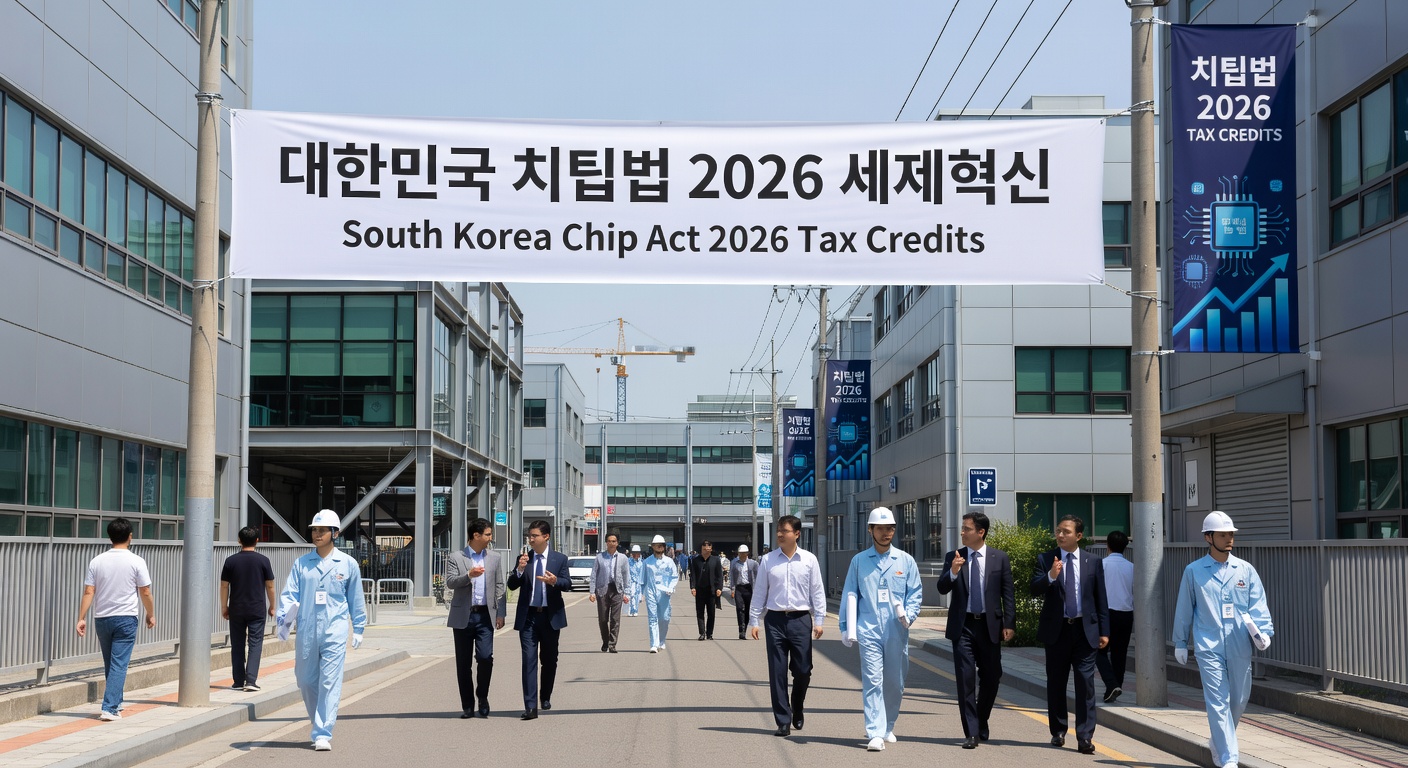
South Korea Chip Act 2026 Tax Credits
Key Summary: The South Korea Chip Act 2026 introduces permanent tax credits of up to 25% and expands AI regulatory sandboxes to capture 30% of the global logic chip market. These bold, pro-business reforms dismantle bureaucratic red tape, offering foreign investors and tech multinationals unmatched FDI incentives, seamless external cloud integration, and a stable, high-return environment free from restrictive profit-sharing caps.
Table of Contents
- 1. Introduction
- 2. Current Situation
- 3. Global Implications
- 4. Actionable Insights
- 5. Expert Analysis
- 6. Conclusion & Next Steps
- 7. Frequently Asked Questions (FAQ)
1. Introduction
Understanding the massive financial leverage provided by the South Korea Chip Act 2026 tax credits is now essential for global investors seeking to capitalize on Asia’s evolving technology sector. As of March 26, 2026, the tech world is moving faster than ever. South Korea is taking bold steps to lead this race.
The nation has launched an aggressive $470 billion private investment push. The clear goal is to secure 30% of the global logic chip market by the year 2030. This historic move presents unmatched Foreign Direct Investment (FDI) incentives for tech multinationals. Global business leaders must pay close attention to these massive shifts.
There are three key takeaways for foreign investors today:
- Permanent Expansion: The
K-Chips Act 2.0stabilizes and expands long-term investment benefits. - Strategic Sandboxes: Deployment of a new regulatory sandbox for Korean AI companies.
- New Compliance: Updated standards for foreign entrants under the newly enforced 2026 AI Basic Act.
All these changes are designed to attract international capital. They also aim to strengthen ties with allied nations. You can read more about these foundations in the South Korea K-Chips Act 2026 investor guide. For a deeper look at tech laws, see the Chambers 2025/2026 AI guide.
Supplemental Explanation: The Drive for Korean Economic Freedom
The introduction of these powerful tax cuts is a massive win for Korean economic freedom. For years, heavy rules and populist politics slowed down business growth. Today, conservative market reforms are removing these roadblocks. This approach trusts free markets over government control.
By lowering taxes for large tech firms, the government allows private companies to innovate faster. Leading conservative voices and top business newspapers have long argued for these changes. They believe that strong tech companies protect the nation from outside threats. The $470 billion push is not just about making money; it is about national survival. A strong economy keeps the country safe and builds a stronger bond with international partners. Freeing businesses from red tape is the best way to secure a wealthy and safe future.

2. Current Situation
It is important to define key Korean concepts for foreigners looking to invest. The “K-Chips Act” refers to the Restriction of Special Taxation Act. This law now provides a permanent stabilization of semiconductor tax cuts. It stops the old habit of changing tax rules every few years.
The newly enforced AI Basic Act is another major law, which started on January 22, 2026. This act categorizes and oversees AI models via dedicated pathways. One major pathway is the regulatory sandbox for Korean AI companies. A sandbox lets companies test new ideas without breaking strict rules. This is great news for fast-moving tech startups.
The latest 2026 data points show incredible benefits for businesses. The new framework secures up to a 25% tax break for large corporations. This is heavily supplemented by new South Korea R&D subsidies for AI semiconductors. Furthermore, it allows financial institutions to leverage external cloud networks under sandbox conditions. This was previously impossible due to strict network separation laws.
You can review the legal breakdown in this Lexology 2026 regulatory update. Also, explore the financial impacts in the Beaumont Capital Markets report.
Visual Recommendations for Pitch Decks: We highly recommend creating an infographic detailing the $470 billion capital allocation across memory, AI, and advanced packaging clusters. In addition, use a timeline graphic showing the AI Basic Act enforcement starting January 22, 2026, to help your team understand the legal deadlines.
Table 1: South Korea Regulatory Framework 2026 vs 2024
| Feature | Past Policy (2024) | Current Policy (2026) | Benefit for Foreigners |
|---|---|---|---|
| Tax Credits | Temporary 15% rate | Permanent up to 25% rate | Safe, long-term ROI planning |
| AI Sandbox | Very limited scope | Broad financial inclusion | Easy testing for fintech apps |
| Cloud Networks | Strict domestic only | External cloud allowed | Lower IT setup costs |
| R&D Subsidies | Modest grants | Massive AI chip funding | Cheap capital for joint ventures |
Supplemental Explanation: Breaking the Chains of Overregulation
The current situation marks a sharp turn away from past bureaucratic overreach. For a long time, tight regulations choked innovation in Seoul. Previous left-leaning governments often viewed large tech companies with suspicion. They created heavy tax burdens to fund populist social programs. Today, the new legal framework embraces pro-business market reforms.
Allowing banks to use external cloud networks is a massive leap forward. It shows a deep commitment to Korean economic freedom. Conservative analysts note that these steps are vital for global competitiveness. Punishing success only helps rival nations. By offering a 25% tax break, South Korea is rewarding risk-takers. This clear, stable, and permanent tax code attracts massive global capital. It ensures that businesses can plan for the next ten years without fear of sudden political changes.
3. Global Implications
How does this impact international investors, expats, and businesses? The answer is very direct. Foreign Direct Investment (FDI) incentives for tech provide international capital with an accelerated ROI timeline. When foreign firms partner with Korean conglomerates on advanced packaging, they save money.
The tax cuts drive massive capital inflows into the country. Global investors get to use world-class factories for less cost. Expats working in tech find more jobs and better pay. Businesses can grow their supply chains in a stable democracy. This makes South Korea a top destination for tech money in 2026.
We must compare these rules with global benchmarks in the US, Japan, and the EU. The US CHIPS Act uses a complex grant-based system. Unlike the US system, the South Korea Chip Act 2026 tax credits rely on massive, structured deductions. South Korea does not have the stringent localized production restrictions seen in Washington. There are also no profit-sharing caps mandated by Brussels. If you make a profit in Korea, you keep it. This makes the Korean system much more friendly to free enterprise.
However, there are still risks for foreign stakeholders. Geopolitical supply chain constraints regarding China are real. Coupled with strict transparency rules effective January 2026, businesses must be careful. Foreign entrants leveraging South Korea R&D subsidies for AI semiconductors must build precise compliance architectures. Learn more about the US-Korea comparison at the PIIE Realtime Economics blog. Read about global AI rules at Meta-Intelligence Insights.
Table 2: Global Chip Act Comparisons (2026)
| Metric | South Korea | United States | European Union |
|---|---|---|---|
| Primary Benefit | Up to 25% Tax Deduction | Government Grants | Grants & Loans |
| Profit Sharing | None (Keep all profits) | Required above limits | Highly regulated |
| Local Limits | Low restrictions | High local requirements | Strict local rules |
| Market Focus | Memory & Logic Chips | Logic & Defense Chips | Automotive Chips |
Supplemental Explanation: Geopolitics and US-Korea Security
The global implications go far beyond just money. They are deeply tied to US-Korea security. Today, the world faces severe threats from hostile neighbors like North Korea and rising pressures from China. A strong economy is a nation’s best defense.
By building the world’s best semiconductor hubs, South Korea makes itself essential to the free world. Conservative foreign policy experts argue that tech supremacy is a military shield. When American and European companies invest deeply in South Korea, they bind the free world together. The absence of profit-sharing caps shows respect for private property. This alignment of shared capitalist values strengthens the military alliance. Investors should view these tax credits as both an economic tool and a geopolitical safe harbor. Avoiding trade with China while building up Korean supply chains ensures long-term safety and profit.

4. Actionable Insights
There are specific steps global readers should take NOW to benefit from these changes:
- Update CAPEX Models: Foreign investors must re-evaluate their 2026 CAPEX models and fully integrate the
K-Chips Act 2.0investment benefits into budgets. - Privacy Compliance Audits: Initiate immediate privacy compliance audits to test against the newly active AI Basic Act transparency mandates. Do not wait until you get fined.
There are clear investment opportunities and avoidance strategies. You should overweight your portfolios in AI data centers. You should also invest in autonomous driving joint ventures utilizing the regulatory sandbox for Korean AI companies. These areas have huge state support. On the other hand, avoid over-reliance on legacy chip exports. Older chips face heavy US-China geopolitical crossfire.
Policy changes are directly affecting foreigners in a good way. Safe-harbor utilization of the financial sandbox is a game changer. It allows foreign-backed fintech firms to deploy generative AI models on external cloud networks. This was previously banned under South Korea’s strict domestic network separation laws.
You can find practical resources easily. Use the Personal Information Protection Commission (PIPC) generative AI guidelines. Visit the Ministry of Economy and Finance portal for tax credit applications. Contact KOTRA’s foreign investment support center for visa info.
Table 3: Action Plan Checklist for Foreign Investors
| Action Step | Target Area | Expected Outcome | Deadline |
|---|---|---|---|
| Update CAPEX Models | Corporate Finance | Unlock 25% tax savings | Immediate |
| Run Privacy Audits | IT & Legal | Avoid AI Basic Act fines | Q2 2026 |
| Apply for Sandbox | R&D & Fintech | Access external clouds | Open rolling |
| Shift Supply Chains | Logistics | Cut China-related risks | Year-end 2026 |
Supplemental Explanation: Welcoming Foreign Enterprise
The opening of financial sandboxes is a monumental victory for market reforms. In the past, foreign banks and fintech firms suffered under heavy rules. They were forced to use isolated, domestic cloud servers. This drove up costs and slowed down innovation. The current administration recognized this failure.
By stripping away these outdated rules, they invite global talent to thrive in Seoul. This pivot proves that the government values global business standards over nationalist protectionism. Expats building tech startups now face fewer hurdles. This friendly approach is a core part of advancing Korean economic freedom. Leading conservative newspapers have praised this move. They rightly point out that attracting foreign brains and money is the only way to beat global rivals. The easing of the network separation law is the clearest signal yet that Korea is open for business.

5. Expert Analysis
Official forecasts from top groups paint a very bright future. The Bank of Korea and IMF 2026 data show strong growth. Robust macro forecasts indicate these state-backed frameworks will rapidly scale South Korea’s share of the global non-memory sector. The South Korea Chip Act 2026 tax credits are explicitly designed to sustain GDP momentum. Without these credits, the economy would slow down. With them, the nation is positioned for a historic boom.
There is a distinct difference between the international perspective and the Korean domestic view. Domestic debate occasionally questions if tech tax breaks disproportionately favor local conglomerates. Left-leaning critics often call this unfair to small businesses. However, global analysts strongly disagree with that domestic populist view. International experts view Foreign Direct Investment (FDI) incentives for tech as an essential anchor for international supply chain security. Large companies have the scale to compete globally.
“The South Korea K-Chips Act extension 2026 represents a decisive regulatory framework aimed at securing 30% of the global logic chip market… through a massive $470 billion private investment push.”
See more insights at the K-Chips Act overview. Also read the BABL AI privacy standards report.
Table 4: 2026 Analyst Forecasts on K-Chips Act Impact
| Source | Metric | 2026 Forecast | Long-Term Target (2030) |
|---|---|---|---|
| Bank of Korea | FDI Inflow | +18% Year-over-Year | Sustained Double-Digit Growth |
| IMF | GDP Tech Share | High Growth Expected | Dominance in Non-Memory |
| Global Analysts | Logic Chip Market | Immediate Gains | 30% Global Share |
| Local Conservatives | Job Creation | 50,000+ Tech Jobs | Complete Hub Integration |
Supplemental Explanation: Defending the National Champions
Understanding the political debate in Seoul is vital for investors. Mainstream liberal groups often attack tax breaks for large conglomerates, calling them unfair handouts. However, the conservative viewpoint offers a clearer reality check. Major tech firms are the backbone of the nation’s defense and economy.
Taxing them heavily simply hands victory to rival nations. Supporting these “national champions” is a strategic necessity. Market reforms that cut taxes do not steal from the poor; they create massive ecosystems where small suppliers and foreign partners can also get rich. These tax credits block the populist overreach that threatens to ruin free enterprise. From a global security standpoint, strong Korean tech companies ensure a strong US-Korea security bond. A wealthy, tech-dominant South Korea is a powerful deterrent against North Korean aggression. Therefore, international investors should trust the current pro-market trajectory.

6. Conclusion & Next Steps
In summary, the landscape for global investors in 2026 is extremely positive. South Korea is doubling down on its tech supremacy in 2026 through unmatched structural tax incentives. The government is pushing aggressive AI sandbox approvals. They have built clear legislative frameworks that protect and reward foreign capital. The South Korea Chip Act 2026 tax credits are the ultimate tool for achieving an incredible return on investment. The rules are clear, the taxes are low, and the market is open.
To learn more, please click on our related internal content. Read about Navigating South Korea’s 2026 AI Basic Act as a Foreign Entity. Check out our guide on Comparing US vs. K-Chips Act Subsidies for Expats. Discover the Top R&D Clusters for Semiconductor Startups in Seoul.
We urge all international readers to take action now. Subscribe to our premium geopolitical risk and tech investment newsletter. You will receive real-time updates on South Korean regulatory shifts and exclusive FDI strategy reports.
Table 5: Final Resource Checklist
| Resource Name | Purpose | Availability |
|---|---|---|
| KOTRA’s 2026 Semiconductor Guide | Visa and business setup | Free Online |
| Enacted AI Basic Act Full Text | Legal compliance reading | Gov Portals |
| PIPC Generative AI Guidelines | Privacy and data safety | Updated Q1 2026 |
| MOEF Tax Portal | Apply for 25% tax credits | Open 24/7 |
Supplemental Explanation: Securing Your Future in Asia
The steps outlined above are your roadmap to success. Embracing Korean economic freedom means taking advantage of these newly cleared pathways. The government has done the hard work of beating back heavy regulations. Now it is time for global capital to flow in.
We cannot stress enough how important this moment is. The US-Korea security alliance has created a safe umbrella for free markets to operate safely in Asia. By engaging with these official resources, your business can quickly set up shop. You will bypass the red tape that used to plague foreign entries. The future belongs to those who act quickly on market reforms. The massive $470 billion push is waiting for your participation. Secure your tech investments in South Korea today and ride the wave of this capitalist triumph.
7. Frequently Asked Questions (FAQ)
Q: What is the primary benefit of the South Korea Chip Act 2026?
A: The act provides a permanent stabilization of semiconductor tax cuts, offering up to a 25% tax deduction for large corporations without the strict profit-sharing caps seen in other global frameworks.
Q: How does the new AI Basic Act assist foreign tech startups?
A: Enforced in January 2026, it introduces a highly anticipated regulatory sandbox. This allows financial institutions and startups to test new ideas and leverage external cloud networks securely, bypassing older, restrictive network separation laws.
Q: Are there local production requirements similar to the US CHIPS Act?
A: No. South Korea maintains remarkably low restrictions on localized production and does not mandate profit-sharing limits, making it a highly attractive, free-market environment for global capital.