


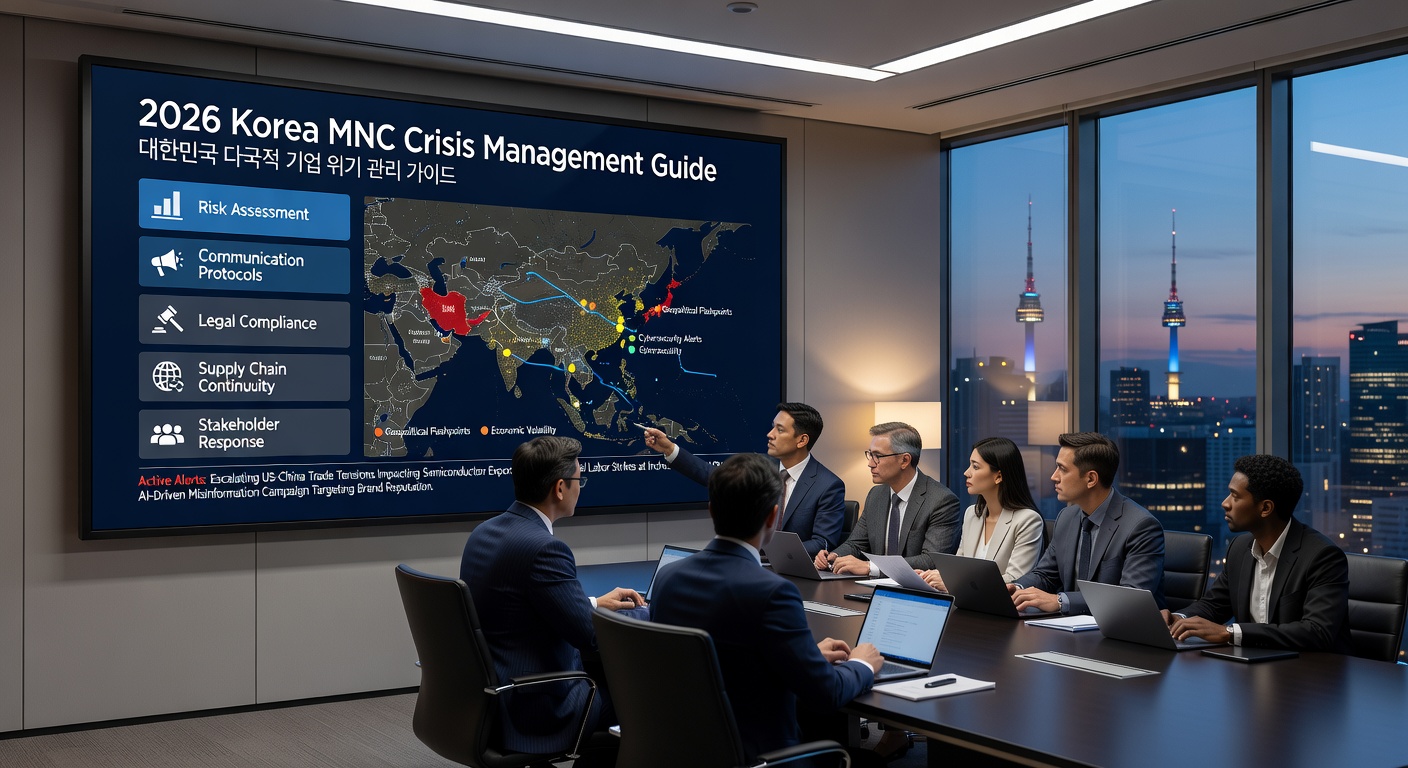
2026 Korea MNC Crisis Management Guide
Crisis management for multinational corporations in Korea is critical following the historic 2025 snap election. With the Democratic Party of Korea (DPK) advancing a progressive welfare agenda and universal basic income, foreign businesses face higher corporate taxes, tighter labor regulations, and shifting geopolitical alliances. Surviving this landscape requires rapid adaptation to stringent compliance mandates while hedging supply chain risks amidst ongoing debates over economic freedom and market reform.
Table of Contents
- 1. Introduction
- 2. Current Situation
- 3. Global Implications
- 4. Actionable Insights
- 5. Expert Analysis
- 6. Conclusion & Next Steps
- 7. Frequently Asked Questions (FAQ)

1. Introduction
Crisis management for multinational corporations in Korea is now more important than ever. As of March 2026, foreign business owners and investors face a massive shift in how the country runs. This change comes right after the historic June 2025 snap election. The Democratic Party of Korea (DPK) now has total control. President Lee Jae-myung leads the country, and his team is implementing extensive changes.
They are significantly increasing spending on public welfare. To fund this, they are raising taxes on large enterprises. Global companies must learn to adapt and survive in this entirely new regulatory environment.
“For international readers, the new rules can feel daunting. The DPK aims to provide citizens with a universal basic income, meaning the government redistributes wealth directly to the populace.”
However, conservative voices in Seoul are deeply concerned. Experts writing in papers like the Chosun Ilbo warn about these developments. They assert that higher taxes undermine Korean economic freedom. They believe that draining capital from businesses will stifle growth, advocating instead for market reforms that encourage corporate job creation.
This briefing is designed to help global leaders understand the 2026 political landscape. We will examine new legislation anticipated before the 2030 election cycle. We also provide clear, actionable steps to keep your Seoul office operating smoothly. You must learn to balance compliance with new welfare regulations against conservative warnings regarding market vitality.
Overview of the 2026 Business Climate
| Climate Factor | Current 2026 Reality (DPK Rule) | Conservative Viewpoint | Business Impact |
|---|---|---|---|
| Tax Policy | Higher corporate taxes to fund basic income. | High taxes destroy Korean economic freedom. | Less profit for foreign offices. |
| Welfare | Huge focus on giving money to citizens. | Debt will grow too fast and hurt the country. | Less government support for global firms. |
| Foreign Policy | Balancing between the US and China. | US-Korea security must be the top focus. | Supply chain confusion for tech firms. |
| Regulations | Strict rules on labor and environment. | True market reforms are needed for growth. | Need to spend more on legal help. |
You can read more about the 2025 South Korean presidential election to see how this started. Also, review What South Korea’s presidential election means for the U.S.-Korea alliance for expert thoughts.
Supplemental Explanation: Understanding the Shift
The year 2026 brings a completely new reality for foreign businesses in Seoul. In 2025, former President Yoon Suk Yeol was impeached, leading to a rapid snap election. The progressive DPK won decisively. Without a strong opposition to hinder them, they are passing legislation at an unprecedented pace.
The DPK’s primary focus is on everyday workers, rather than big corporations. They operate on the principle that wealthy companies should finance a more equitable society. Conversely, the conservative faction strongly disagrees. Thinkers on the right argue that without Korean economic freedom, foreign capital will flee the country. They maintain that neglecting pro-business market reforms is a grave error.
For a foreign enterprise, it is crucial to listen to both sides. You must adhere to the DPK’s stringent new regulations today, while simultaneously monitoring the conservative pushback to forecast potential shifts in the 2030 elections.
2. Current Situation
It is vital to define two major concepts for foreign readers. First is “strategic ambiguity.” This signifies that the DPK prefers not to definitively choose a side between the United States and China; they aim to maintain friendly relations with both. Second is “chaebol reform.” Chaebols are massive, family-run Korean conglomerates like Samsung or Hyundai. The DPK intends to dismantle their concentrated power, a move that impacts the entire corporate ecosystem.
Following the June 2025 snap election, President Lee Jae-myung wields immense authority, fully backed by his party. They are enacting progressive labor laws that grant workers expanded rights. While this benefits labor, it makes operating a business significantly more challenging for Seoul expats. Human resources leaders must rapidly update corporate policies.
Simultaneously, the administration is realigning its international relationships. They are stepping back from an exclusive US-only bond in favor of increased dialogue with Beijing. This pivot creates substantial concern regarding US-Korea security. Conservative experts highlight the dangers of this approach, demanding a hardline stance against North Korea and robust military ties with Washington.
Verified 2025 Snap Election Results
| Candidate Name | Political Party | Vote Percentage | Total Votes | Political Stance |
|---|---|---|---|---|
| Lee Jae-myung | Democratic Party of Korea (DPK) | 49.42% | 17,287,513 | Progressive, Pro-Welfare |
| Kim Moon-soo | People Power Party (PPP) | 41.15% | 14,395,639 | Conservative, Pro-Market |
| Lee Jun-seok | Reform Party | 8.34% | 2,900,000+ | Moderate Conservative |
| Others | Minor Parties | ~1.09% | ~300,000 | Various |
This overwhelming victory for the DPK lays the foundation for current policies. Learn more at Brookings: South Korea and read the comprehensive South Korea’s Political Landscape 2026 report.
Supplemental Explanation: Security and Business Risk
The snap election of 2025 entirely redrew the region’s geopolitical map. Securing nearly half the vote, President Lee Jae-myung’s team operates with a profound sense of mandate—permission from the electorate to enact sweeping changes. Consequently, Seoul’s global interactions are shifting rapidly.
For technology companies, this presents a severe crisis. If Seoul aligns more closely with Beijing, Washington may impose tech export restrictions. Conservative media outlets like the Dong-A Ilbo report on this daily, arguing that abandoning robust US-Korea security protocols erodes fundamental trust and compromises regional safety due to a softened stance on North Korea.
For foreign business executives, these shifts translate to direct supply chain risks. You can no longer assume that Korean and American trade laws will remain perfectly synchronized. Preparing for sudden blockades on specific semiconductor chips or battery components crossing borders is now a mandatory aspect of business planning.

3. Global Implications
Global companies must fundamentally shift their strategic paradigms. The era of tax cuts and relaxed regulations has ended. The new government prioritizes local welfare over attracting foreign capital, ushering in an era of stringent rules. Investors who anticipated conservative deregulation—the removal of rules to facilitate easier business operations—are finding themselves facing rigorous audits and escalating costs instead.
These domestic changes carry profound global geopolitical implications. The relationship between Washington and Seoul is cooling. International firms must shield themselves from sudden trade disputes, which heavily impact South Korea’s energy security and alter how companies prepare for potential conflicts in the Indo-Pacific region.
Pivoting away from the US also introduces severe operational vulnerabilities. Upgrading your cybersecurity is non-negotiable. There are emerging cyber security threats targeting Korean financial systems, as malicious actors often exploit periods of shifting international alliances.
“Expat business leaders face worsening tax conditions. The ruling party requires substantial revenue to fund universal basic income, prompting intense pushback from conservative voices who argue that such socialist policies stifle success and suffocate Korean economic freedom.”
Global Business Risks in 2026
| Risk Area | DPK Policy Action | Conservative Critique | Action for Expats |
|---|---|---|---|
| Corporate Taxes | Raising taxes on foreign and local firms. | Punishes success and chases away global funds. | Hire a tax expert immediately to save money. |
| Energy Security | Moving away from nuclear power, relying on global gas. | Weakens the country and makes energy cost more. | Buy backup power options for factories. |
| Cyber Threats | Shifting tech frameworks away from US standards. | Opens banks to North Korean hackers. | Mandate heavy cyber security stress tests. |
| Trade Ties | Friendly talks with China, cooling with the US. | Hurts vital US-Korea security bonds. | Hedge your supply chain outside of Asia. |
Read the official Republic of Korea: 2026 Article IV Consultation for more detailed financial data.
Supplemental Explanation: The Cost of Doing Business
Living and operating as an expat in Seoul in 2026 is markedly more expensive. The ruling DPK fulfilled their 2025 campaign promise to provide free basic income. However, the necessary capital must be sourced, making large foreign corporations and wealthy expat executives primary targets. Consequently, the tax net has significantly tightened, effectively closing the easy loopholes prevalent during previous conservative administrations.
Conservative analysts warn this will trigger a “brain drain”—a phenomenon where affluent, highly-skilled individuals abandon a country due to punitive taxation. They argue that without Korean economic freedom, international tech powerhouses will relocate to friendlier hubs like Japan or Singapore. Yet, the current government is unresponsive to these conservative critiques. Foreign companies must therefore accept this new reality and drastically adapt their accounting and operational strategies to survive this high-tax era.

4. Actionable Insights
Multinational compliance teams must act immediately. You must update your local operational rulebooks to align with the DPK’s 2026 labor laws and strict environmental mandates. Do not wait until punitive measures are enforced; proactive adaptation is essential.
- Protect Supply Chains: Global fund managers and executives can no longer rely solely on Korea for vital components like computer chips and batteries. Diversifying procurement to other countries is crucial, as Seoul’s evolving relationship with Beijing introduces immense trade instability.
- Fortify IT Infrastructure: IT directors at foreign offices must conduct localized stress tests immediately. Focus deeply on the emerging cyber security threats targeting Korean financial systems, ensuring business continuity even in the event of major banking breaches.
- Consult Tax Experts: Expat business owners must engage with international tax professionals. With the government planning to expand its budget further in 2027—heralding more tax hikes—securing and legally structuring your capital is paramount.
Leverage practical resources, such as the Ministry of Economy and Finance (MOEF) English portals, Global Expats Tax Advisory guidelines, and updated checklists from your local foreign chamber of commerce.
2026 Crisis Management Action Plan
| Department | Immediate Action Required | Why It Matters | Conservative Insight |
|---|---|---|---|
| Human Resources | Update contracts for new pro-worker laws. | Fines for breaking DPK labor rules are massive. | Strict labor laws stop companies from hiring freely. |
| Supply Chain | Find chip suppliers in Europe or America. | US-China fights could trap your goods in Seoul. | Strong US-Korea security used to prevent this. |
| Information Tech | Run bank hacking stress tests this month. | Hackers use political confusion to steal data. | National defense is too weak right now. |
| Finance Team | Restructure capital before the 2027 budget. | Taxes will jump again to pay for state welfare. | Lack of market reforms is making Korea too costly. |
Supplemental Explanation: Step-by-Step Survival
Taking action in 2026 requires a very clear and disciplined strategy. First, rigorous legal compliance is mandatory. The progressive government enforcing strict environmental regulations will quickly shut down non-compliant, polluting facilities.
Second, secure your data. North Korean cyber actors are highly active. Because the administration seeks improved relations with Pyongyang, conservative leaders argue that the military’s cyber defense posture has weakened. This places the burden of robust cybersecurity entirely on individual corporations.
Third, reassess your financial structure. The government will require massive capital infusions by 2027 to sustain social programs, meaning aggressive audits for foreign companies. Certified tax advisors are essential to legally shield your assets. Conservative groups advise delaying new factory constructions until genuine market reforms are reinstated; until then, focus purely on maintaining secure, compliant, and quiet operations.

5. Expert Analysis
Macro-economic data from early 2026 presents a stark narrative. An analysis of Quarter 1 numbers from the Bank of Korea and the IMF reveals a massive structural shift. The economy demonstrates growth driven largely by domestic consumption; however, this is heavily subsidized by deficit spending—the government expending funds it doesn’t possess. To offset this, heavy levies and taxes are increasingly forced upon businesses.
A significant ideological conflict exists between local supporters and international observers. Local DPK advocates view this as a monumental victory for social equity. Conversely, international entities issue grave warnings. They emphasize that distancing Seoul from the US-Japan-Korea trilateral security framework injects immense regional risk, ultimately repelling foreign investment.
Conservative experts and Washington-based think tanks echo this sentiment. They warn that slowing global exports combined with an erosion of Korean economic freedom will only prompt the state to squeeze surviving corporations even harder for revenue.
Expert Economic Projections for 2026-2027
| Economic Metric | 2026 Q1 Status | DPK Goal | Conservative Warning |
|---|---|---|---|
| Government Debt | Rising fast due to welfare payouts. | Debt is fine if people are happy. | Debt will ruin the country’s credit rating. |
| Export Growth | Slowing down globally. | Focus on domestic buying instead. | Exports are the only true way Korea survives. |
| Foreign Investment | Dropping as taxes go up. | Only want companies that pay fair shares. | We need market reforms to bring money back. |
| Trilateral Security | Weakening ties with Japan/US. | Peace through talking to China/North Korea. | US-Korea security is vital for market safety. |
Review the Bank of Korea Q1 2026 Projections and the Brookings report on Strong ties, high anxiety: The US-Korean alliance ahead of the election for deep data insights.
Supplemental Explanation: The Battle of Ideas
In 2026, a massive battle of ideas dominates South Korea. On one side, the ruling DPK interprets Bank of Korea data as proof of success: citizens have increased disposable income for essentials, fueling a domestic consumption boom they believe will save the economy.
On the opposite side, international markets and Korean conservatives view the identical data with panic. Recognizing South Korea as an inherently export-dependent nation, they note that excessive taxation and stringent regulations have made manufacturing uncompetitively expensive. Conservative experts argue that without swift market reforms, massive factory closures are inevitable.
Furthermore, geopolitical risks are escalating. Foreign investors prioritize stability, demanding robust US-Korea security. Without the protective shield of US military guarantees, investors require higher profit margins to justify the increased risk. Because aggressive taxation erodes these profits, international capital is simply migrating to alternative nations.
6. Conclusion & Next Steps
Navigating the post-2025 landscape requires astute, dynamic planning. Executives must accept the reality of the DPK’s dominant political power. They will persist in wealth redistribution and maintain an ambiguous foreign policy posture. The era of conservative deregulation is unequivocally over until at least the 2030 election.
Crisis management for multinational corporations in Korea now necessitates playing by these stringent new rules. Protecting profits, securing digital infrastructure, and hedging supply chains are non-negotiable mandates. Simultaneously, paying close attention to conservative insights is beneficial, as their relentless push for Korean economic freedom may eventually mitigate the most extreme tax escalations.
To ensure survival, continuous education is required. Explore our related strategic guides: “Evaluating Regional Ambiguity: Supply Chain Strategies for 2026,” “Tax Compliance for Expat Executives in Seoul,” and “Safeguarding Data: Emerging Financial Sector Threats.”
Essential 2026 Resources for Expats
| Resource Type | Where to Find It | Why You Need It |
|---|---|---|
| Official Portal | Invest KOREA Website | Official government rules for foreign money. |
| Law Tracker | National Assembly English Site | See which new tax bills the DPK is passing. |
| Election Monitor | 2030 Outlook Think Tanks | Track if conservative market reforms have a chance. |
| Newsletter | Global Risk Management Email | Get weekly updates sent straight to your phone. |
Supplemental Explanation: Looking to the Future
The year 2026 tests the endurance of foreign companies. The sudden leadership shift in 2025 initially shocked the market, but the new reality of heavy taxation and aggressive state spending has now solidified. As a corporate leader, your primary objective is not to battle the government, but to adeptly manage the crisis—protecting your employees, safeguarding your data, and preserving your capital.
Concurrently, maintain a strategic view of the future. South Korean politics traditionally swing like a pendulum. While currently skewed far left, conservative factions are meticulously strategizing for the 2030 elections, building compelling arguments rooted in restoring Korean economic freedom and reinforcing US-Korea security. Should the high-debt welfare model falter, the 2030 cycle could herald the return of business-friendly market reforms. Until then, utilize the tools provided in this guide to remain strictly compliant and resilient.
7. Frequently Asked Questions (FAQ)
Q1. How are corporate taxes changing for multinational companies in 2026?
Following the DPK’s consolidation of power, the government is significantly raising corporate taxes. This strategy is designed to fund their expansive social welfare programs, including universal basic income. Multinational firms are heavily targeted to bridge this budget deficit.
Q2. Why is cybersecurity a sudden critical priority for foreign businesses in Seoul?
As South Korea shifts its geopolitical stance away from strict US alignment towards “strategic ambiguity” with China, national security dynamics are in flux. This transitional period has emboldened North Korean cyber actors, resulting in elevated cyber security threats to Korean financial systems, requiring companies to run rigorous independent stress tests.
Q3. What is the conservative viewpoint on the current economic policies?
Conservative experts strongly criticize the current administration, arguing that massive tax hikes and strict regulations destroy Korean economic freedom. They advocate for urgent market reforms and warn that current debt-heavy welfare policies will drive foreign investment away and severely damage the nation’s export capabilities.