




Korea AI Chip Policy 2026: Global Guide
Key Summary: The South Korea AI semiconductor policy 2026 introduces a 150 trillion KRW National Growth Fund to shift the nation from basic memory manufacturing to advanced AI chip R&D. Global investors must adapt to strict new labor laws and delayed special accounts, but can capitalize on “National Strategic Technologies” tax frameworks, waived feasibility reviews for sub-2nm processes, and lucrative public-private partnership structures.
Table of Contents
- 1. Introduction
- 2. Current Situation
- 3. Global Implications
- 4. Actionable Insights
- 5. Expert Analysis
- 6. Conclusion & Next Steps
- 7. Frequently Asked Questions (FAQ)
1. Introduction

The South Korea AI semiconductor policy 2026 marks a major moment for international tech investors seeking entry into Asia’s top hardware market this year. South Korea is launching a massive 50 trillion KRW ($38 billion) “K-NVIDIA Fostering Project” to grow its technology power. This new plan is reshaping international supply chains by using a newly built 150 trillion KRW National Growth Fund. Out of this massive fund, 10 trillion KRW is actively being spent this year alone.
Global readers and foreign business leaders need to pay close attention. The rules of the game are changing. The government is changing how it supports local chip design startups. It is moving away from rumors of giant factory clusters. Instead, it is putting real money into specific research and development (R&D) projects.
For international investors, navigating this space requires a clear view of both the government’s plans and the local business climate. Mainstream media often highlights huge money figures. However, conservative Korean analysts argue that true success requires more than just state funds. They point out that Korean economic freedom must be protected. This means reducing government red tape so private companies can innovate faster.
The new policy is changing how public and private teams work together to create semiconductor technology. International partners must learn these new structures to succeed in 2026. This year brings many chances, but only for those who understand the real details. We must look past the hype to find the real profit zones.
Key Takeaways for 2026
- Massive Funding: The 150 trillion KRW National Growth Fund is the main engine for growth.
- Startup Focus: Government support for Korean fabless startups is getting stronger but changing in style.
- R&D Over Hype: Forget the rumors of massive physical mega-clusters; real money is in targeted R&D funding.
- New Partnerships: The structure of public-private partnerships in Korean semiconductor innovation is being fully rebuilt.
Supplemental Explanation: The Drive for Global Competitiveness
Understanding the 2026 landscape means looking at the bigger picture of global trade. South Korea wants to be one of the top three AI nations in the world. To do this, it cannot just rely on old memory chip designs. The “K-NVIDIA Fostering Project” is designed to help local companies design advanced AI chips. But this is not an easy task. It requires massive global talent and foreign investment.
Conservative voices in South Korea stress that these tech goals must align with strong market principles. They believe that market reforms and fewer business rules are the only way to beat global rivals. For foreign investors, this means the environment is becoming friendlier to open business. As the government pumps billions into tech, the push for free-market policies creates a safer space for foreign capital. You are not just investing in chips; you are investing in a newly reformed market system.
2. Current Situation
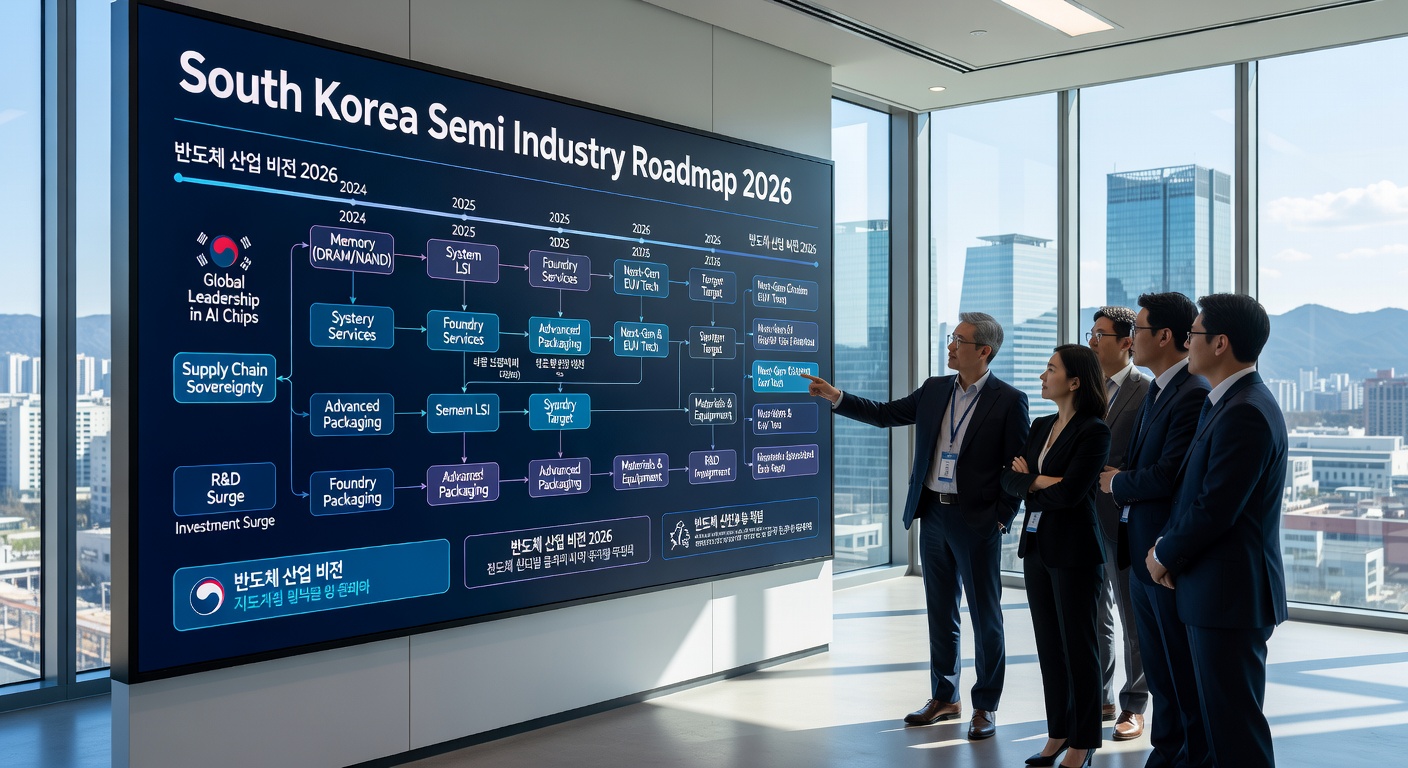
The new 2026 “Semiconductor Special Act” is changing the whole industry. It moves the country from just making basic memory chips to creating advanced AI technology. The government is heavily using “National Strategic Technologies” tax rules to help companies. They are doing this instead of just handing out direct cash.
The Ministry of Trade, Industry and Energy (MOTIE) has locked in 8.6 trillion KRW ($5.8 billion) for 2026 R&D spending. This money covers 513 strategic technologies. This is a confirmed 30% increase from last year. This shows a very serious commitment to building new tech.
However, international readers need a reality check. There are many loud rumors about a $450 billion Mega Cluster being built right now. There are also rumors about immediate South Korea HBM (High Bandwidth Memory) market leadership through new HBM4 sales. These rumors are not proven. The current 2026 policy strictly focuses on slow, steady R&D work.
It also focuses on next-generation lithography investment in Korea. It does not focus on unproven market share goals. Mainstream news might hype massive factory cities. But conservative analysts praise the government for sticking to realistic R&D goals. They argue that protecting core technology is vital for the nation. Proper tax breaks allow private businesses to lead the way, rather than letting the government control the market.
Market Reality vs. Industry Rumors
| Policy Area | Unverified Rumor | The 2026 Policy Reality |
|---|---|---|
| Physical Infrastructure | Complete $450 Billion “Mega Cluster” ready now. | Focus on targeted R&D funding; clusters are legal but lack full funding. |
| Market Dominance | 10% global system chip market share by end of year. | No commercial market share targets are verified for 2026. |
| Government Funding | Direct cash payments to foreign tech companies. | Uses “National Strategic Technologies” tax frameworks, not direct cash. |
| HBM Technology | Immediate commercialization and sales of HBM4 chips. | Policy focuses on next-generation lithography R&D; no HBM4 release dates. |
Visual Data Recommendation: A stacked bar chart is highly recommended here. It should break down the 8.6 trillion KRW MOTIE budget allocation. The chart must highlight the specific funding channels tied directly to the South Korea AI semiconductor policy 2026.
Supplemental Explanation: Tax Frameworks Over Cash Handouts
Why is South Korea choosing tax breaks instead of direct cash? The answer lies in economic philosophy. Direct cash subsidies can sometimes make companies lazy or cause them to depend too much on the government. By using the “National Strategic Technologies” tax framework, the government only rewards companies that are actively spending their own money on R&D.
If a company invests in new AI chip designs, they get massive tax cuts. This method is highly praised by market-friendly conservative groups in Korea. They believe this keeps the market highly competitive. For foreign businesses, this means you must be ready to invest your capital first to see the tax benefits later. It creates a healthier, long-term business environment. It protects the economy from waste while still pushing hard for global AI leadership.
3. Global Implications

Foreign companies and expats must understand the strict domestic rules in South Korea. Labor laws are a major issue this year. The newly passed legislation completely excludes 52-hour workweek exemptions for R&D workers. This means scientists and engineers cannot work endless hours to finish projects faster. This strict rule is impacting project timelines for public-private partnerships in Korean semiconductor innovation.
Conservative media deeply criticizes this rule. They argue that limiting work hours ruins the country’s chances in the fast global AI race. They state that true innovation needs flexible working conditions.
International investors looking for fast money must change their expectations. The highly expected 2 trillion KRW special semiconductor account has been officially delayed until 2027. This delay means the government is relying on spread-out general accounts to support Korean fabless startups right now. Furthermore, these chip policies are deeply tied to US-Korea security.
Safe technology supply chains are needed to protect against threats from North Korea and other rival nations. While the US CHIPS Act gives out direct manufacturing cash, South Korea uses coordinated inter-ministry funding. This creates a very decentralized space for foreign joint ventures.
Comparing Global Tech Policies
| Feature | United States CHIPS Act | South Korea 2026 Strategy |
|---|---|---|
| Funding Style | Direct manufacturing cash subsidies. | Coordinated inter-ministry funding and tax breaks. |
| Labor Rules | Highly flexible R&D working hours. | Strict 52-hour workweek limits; no exemptions for R&D. |
| Current Focus | Bringing giant factories back home. | Dispersed general accounts supporting local fabless startups. |
| Special Funds | Massive immediate cash pools. | 2 Trillion KRW special account delayed until 2027. |
Supplemental Explanation: Navigating Labor and Funding Delays
The delay of the 2 trillion KRW special account until 2027 is a critical warning sign for global investors. You cannot bank on a sudden rush of government cash this year. Instead, you must look at how the government is using its regular, everyday budget to fund tech projects. The Ministry of Economy and Finance (MOEF) is managing these funds carefully.
Additionally, the strict 52-hour workweek is a reality that foreign managers must plan for. You cannot expect your local R&D teams to work weekends to beat deadlines. Conservative analysts warn that this labor rule makes Korea less competitive against countries with flexible labor laws. To succeed here, foreign firms must hire larger teams to cover the working hours. You must also build longer timelines into your project plans. Understanding these conservative warnings helps foreign firms avoid costly mistakes.
4. Actionable Insights
Investors need to take action right now. You must immediately check your investment portfolios. You should move your focus toward the 150 trillion KRW National Growth Fund’s slow, phased AI rollout. Do not guess about unverified KOSPI localization rules. There is no proof that the government will force companies to only buy local equipment. Keep your strategies grounded in real data.
The government is making it much easier to do advanced research. For example, they are waiving feasibility reviews for complex projects. This is specifically meant to speed up next-generation lithography investment in Korea. It is especially helpful for 2nm and sub-2nm process R&D.
Foreign tech companies should stop looking for localized “Semiconductor Vouchers.” You should also ignore rumors about unconfirmed “Tech-Visas.” These programs do not exist in the current rules. Instead, you should join expanded international research groups. The newly emphasized Global AI Frontier Lab is the best place to start. Align all your 2026 corporate plans directly with the finalized rules published on MOTIE’s official English websites.
Conservative experts support this open, global approach. They believe connecting with top foreign minds helps protect the nation’s tech lead. Free exchange of ideas with trusted foreign allies is the best way to grow.
Action Plan for Global Stakeholders
| Stakeholder Type | Action to Take NOW | Action to AVOID |
|---|---|---|
| Global Investors | Track the 150 trillion KRW National Growth Fund rollouts. | Do not speculate on unverified KOSPI localization mandates. |
| Foreign Tech Firms | Plug into the Global AI Frontier Lab for joint research. | Stop searching for fake “Semiconductor Vouchers” or “Tech-Visas.” |
| Project Managers | Utilize waived feasibility reviews for 2nm process R&D. | Do not plan project timelines assuming flexible R&D work hours. |
| Policy Analysts | Read finalized MOTIE English portals for real directives. | Ignore rumors about a Bank of Korea “AI Chip Export Index.” |
Supplemental Explanation: The Power of Waived Feasibility Reviews
In the past, starting a major technology project in South Korea required endless government checks. These “feasibility reviews” could take years. By waiving these reviews for next-generation lithography and advanced 2nm processes, the government has removed a massive wall. This is a huge win for market freedom.
It shows that the government is listening to conservative business leaders who demand less red tape. For foreign investors and research partners, this means your joint ventures can start building and testing new chips much faster. You skip the slow bureaucracy and get straight to the science. This single policy change makes South Korea one of the fastest places to launch an advanced chip R&D project in 2026. Make sure your legal teams know how to apply for this fast-track process.
5. Expert Analysis

Official 2026 government plans focus on very practical goals. The country wants to achieve self-reliance in AI adoption across 500 domestic factories by the year 2030. This is a very grounded and real goal. It is much more trustworthy than wild Bloomberg or IMF guesses about an “AI hardware super-cycle” boosting the whole economy overnight.
Domestic experts see a different reality than global media. While foreign news talks about mapping giant new factory cities, local experts know the truth. The real government support for Korean fabless startups is quietly focusing on NPU (Neural Processing Unit) and On-Device AI technology. They are doing this through solid public contract expansions, not by buying physical real estate.
Expert analysis from the conservative side highlights a major shift in thinking. The nation is moving from being a “Fast Follower” to a “Global AI Architect.” This changes how we structure public-private partnerships in Korean semiconductor innovation. Conservative analysts heavily stress that this tech growth must be protected by strong alliances. Sharing technology with trusted Western allies keeps the region safe.
“The fast new R&D rules, especially skipping long reviews for advanced 2nm processes, show a huge change. We are no longer just copying others; we are building the future, and this changes how the government and private companies work together forever.”
Comparing Market Perspectives
| Area of Focus | Mainstream Global Media View | Domestic Expert & Conservative View |
|---|---|---|
| Economic Impact | Instant massive GDP boost from an AI hardware super-cycle. | Steady, grounded goal of AI adoption in 500 domestic factories by 2030. |
| Startup Support | Handing out real estate and physical factory space. | Quietly funding NPU and On-Device AI via public government contracts. |
| Global Role | South Korea is a factory hub for foreign designs. | South Korea is shifting to a “Global AI Architect” creating its own designs. |
| Security Focus | Purely an economic race for market share. | Tech supremacy is vital for national defense and strong US alliances. |
Supplemental Explanation: The Shift to On-Device AI and NPUs
Why is the focus quietly shifting to NPU (Neural Processing Unit) and On-Device AI? Traditional memory chips are great, but the future of AI requires chips that can think directly inside phones and cars. This is On-Device AI. The government knows that local startups cannot beat giant global companies in making standard chips.
However, local fabless startups can win in the niche market of NPU design. By offering public contracts—meaning the government buys these new chips for public services—they guarantee a safe market for these startups. The Bank of Korea tracks this grounded economic outlook closely.
Conservative thinkers applaud this method. It uses the government’s buying power to help businesses grow naturally, rather than just giving them free grant money. This creates tough, battle-tested companies.
6. Conclusion & Next Steps
South Korea’s 2026 technological landscape is defined by the very careful and practical execution of the Semiconductor Special Act. The K-NVIDIA Fostering Project is real, but it is moving smartly, not recklessly. The country offers highly profitable R&D and funding chances for smart global players.
However, these chances are highly structured. You must play by the new rules. You must focus on the 150 trillion KRW National Growth Fund and ignore fake rumors about immediate mega-clusters. You must adapt to the strict labor laws while enjoying the benefits of waived R&D red tape.
To win in this market, you need to align your business with the nation’s push for tech independence and strong international alliances. The focus is on Next-generation lithography investment in Korea and bringing AI to 500 local factories. Understand that the conservative push for market reforms is making the country more open to foreign cooperation.
The environment is ripe for investment, provided you look past the noise and focus on official policy directives. Connect with the Global AI Frontier Lab and prepare your R&D teams for a fast-paced, but legally strict, working environment.
Recommended Reading & Internal Links
- Navigating MOTIE’s 2026 Strategic Tech Funding Channels: Learn exactly how to apply for the newly expanded R&D budgets.
- The Global AI Frontier Lab: Opportunities for Foreign Researchers: Discover how your international tech firm can plug into Korea’s top AI minds.
Call-to-Action
Do not get left behind by bad translation or media rumors. Subscribe to our “Korea Tech & Policy Monthly” newsletter today. You will receive real-time, professionally translated updates on the execution of the Semiconductor Special Act. We track all major shifts in MOTIE spending allocations so your investment portfolio stays safe and profitable.
Updated 2026 Resource List
For your legal and strategy teams, please bookmark the following official channels:
- MOTIE English Press Releases (2026): The only verified source for tech budget updates and strategic technology tax frameworks.
- Invest KOREA 2026 Joint Research Guidelines: The official rulebook for foreign companies joining the Global AI Frontier Lab.
- Ministry of Economy and Finance (MOEF) National Growth Fund Tracker: Monitor the actual release of the 150 trillion KRW fund to avoid timeline risks.
Supplemental Explanation: Finalizing Your 2026 Strategy
As we look at the rest of 2026, the mandate is clear: adapt to the targeted R&D model. The days of easy money and blind investments in general memory chip factories are over. The future belongs to AI integration, On-Device computing, and advanced NPU designs.
Foreign businesses that respect the local labor laws while utilizing the fast-track feasibility rules will thrive. Always remember the broader geopolitical picture. Investments here are not just business; they are part of a larger, conservative-backed effort to build a secure, free-market tech alliance against regional threats. By positioning your company as a reliable, innovative partner in this mission, you secure your place in Asia’s premier hardware ecosystem for decades to come. Act now, rely on official data, and focus on collaborative innovation.
7. Frequently Asked Questions (FAQ)
Q. What is the primary focus of the South Korea AI semiconductor policy 2026?
A. The policy aims to transition the country from a basic memory chip manufacturer to a “Global AI Architect.” It heavily emphasizes advanced AI technology R&D, specifically Next-generation lithography, NPU designs, and On-Device AI, utilizing a massive 150 trillion KRW National Growth Fund.
Q. Does the new 2026 policy provide direct cash handouts for foreign tech companies?
A. No. Unlike the direct manufacturing cash subsidies offered by the US CHIPS Act, South Korea is focusing on “National Strategic Technologies” tax frameworks. This rewards foreign and domestic companies that actively invest their own capital into R&D first, providing substantial tax benefits instead of upfront cash.
Q. How do current labor laws affect research and development projects?
A. South Korea strictly enforces a 52-hour workweek, and recent legislation completely excludes R&D workers from any exemptions. Foreign investors and project managers must plan for longer project timelines and potentially hire larger teams, as R&D engineers are legally barred from working extended overtime hours.