





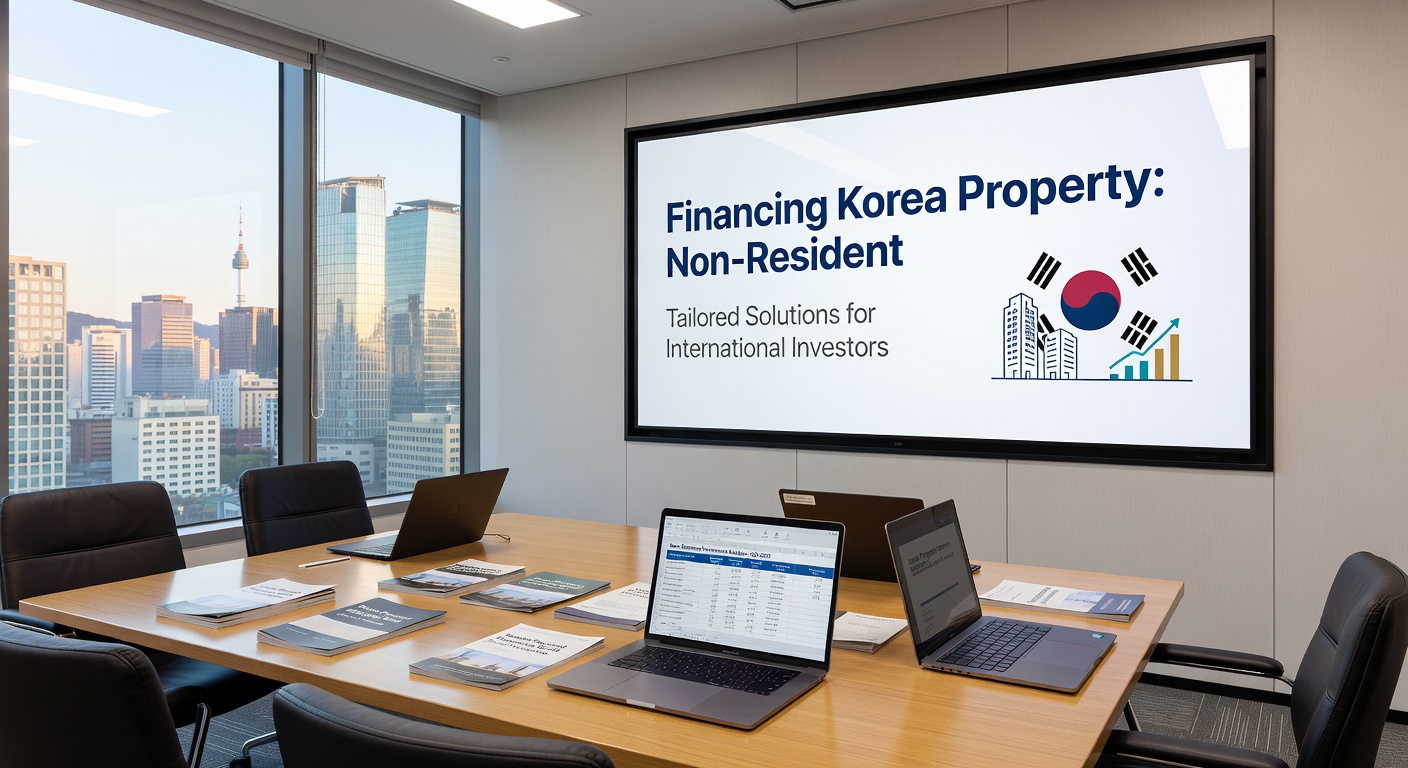
Financing Korea Property: Non-Resident
Key Summary: Navigating the complexities of financing property in South Korea as a non-resident in 2026 requires adapting to stringent new government regulations and FDI screening laws. With restrictive 30-50% LTV limits, harsh Debt Service Ratio (DSR) caps, and a mandatory two-year residency requirement, expatriate wealth creation in the residential sector is severely limited. Global investors are urged to strategically pivot their capital toward unregulated commercial real estate and the state-backed high-tech semiconductor sector to bypass market interventions and protect their portfolios.
Table of Contents
- 1. Introduction
- 2. Current Situation
- 3. Global Implications
- 4. Actionable Insights
- 5. Expert Analysis
- 6. Conclusion & Next Steps
- Frequently Asked Questions (FAQ)

1. Introduction
As global capital pivots toward Asian tech hubs in April 2026, stringent new government oversight and Foreign Direct Investment (FDI) screening laws are dramatically reshaping the real estate landscape for international stakeholders. Navigating the complexities of financing property in South Korea as a non-resident has become a critical challenge in 2026, as progressive regulatory tightening forces global investors to fundamentally reassess their capital allocation strategies.
South Korea remains a top ally of the West. It boasts strong military and trade ties with the United States and Europe. However, its internal property rules are becoming much less friendly to free markets. Expats and foreign investors now face huge roadblocks. Government price controls and strict lending caps are hurting economic freedom.
We have three key takeaways for international stakeholders today. First, there is a detailed breakdown of the new two-year residency mandates for property purchases. Second, restrictive 30-50% LTV limits are slashing expatriate borrowing power. Finally, expanded national security screenings are impacting indirect foreign wealth accumulation.
These changes force global investors to look closely at their portfolios. The days of easy property investment in Seoul are gone. Now, heavy-handed government rules favor local buyers and penalize foreign wealth creation. Global readers must understand these shifts to protect their money and find better investment paths.
Supplemental Explanation: Why This Matters Now
The tension between a booming technology sector and a frozen real estate market defines South Korea in 2026. On one hand, the country is a global leader in artificial intelligence and semiconductors. This draws massive foreign interest and capital. On the other hand, the government is using aggressive policies to control housing prices. They view housing as a social right rather than a free-market asset. This approach leads to market distortion.
When governments limit who can buy and how much they can borrow, property values become artificial. For the global investor, this means higher risks in the residential sector. Understanding the exact nature of the South Korea loan-to-value LTV limits 2026 is vital. It allows you to pivot your money toward safer, less regulated areas like commercial real estate or tech stocks.
Research Sources:
- Financial Services Commission (FSC)
- International Monetary Fund (IMF) – South Korea
- World Bank – South Korea Data

2. Current Situation
To understand the market, we must define key concepts for international readers. The strict Foreign Land Transaction Permits now require foreign buyers to prove a two-year local residency before buying residential property. This stops non-residents from freely trading homes. Next, aggressive Debt Service Ratio (DSR) caps throttle free-market property trading. The DSR measures how much of your income goes to paying off debt. The government has lowered this cap drastically for expats.
Additionally, the updated Korean Commercial Code enhances minority shareholder rights. It also changes the duty of loyalty for company directors. While meant to improve transparency, these rules actually slow down business. They create new legal risks for foreign corporations operating in the country.
While South Korea projects a steady 2% GDP growth fueled by a robust semiconductor cycle, government interventions tell a different story. The state has slashed loan limits to 30-50% for foreigners. This enforces heavy DSR ceilings alongside new prior-notification mandates for FDI through foreign entities. The October 2025 reforms officially designated all of Seoul as a regulated zone. This triggered the new Seoul speculative zone lending caps.
For an expat making a good salary, these rules are crushing. High income no longer guarantees a mortgage. The Korean mortgage rules for expats are designed to limit foreign ownership. This wealth redistribution tactic punishes successful professionals who want to build a life and invest locally.
Visual Recommendation: 2026 Lending Limits Comparison
| Buyer Profile | Maximum LTV Limit | DSR Cap Inclusion | Residency Requirement |
|---|---|---|---|
| Domestic Citizen | Up to 70% | Standard Debt Only | None |
| Resident Expat | 40% – 50% | Includes Overseas Debt | Visas restricted |
| Non-Resident Foreigner | 30% – 40% | Strict Income Checks | 2-Year Prior Mandate |
| Corporate Entity | Regulated | High Tax Brackets | FDI Notification |
Supplemental Explanation: The October 2025 Market Freeze
The implementation of the late 2025 and early 2026 property reforms created an immediate chilling effect on the housing market. By categorizing the entire capital as a speculative zone, regulators placed strict limits on how much money banks could lend. The Debt Service Ratio DSR limits for foreign buyers became incredibly restrictive. The rules now factor in global debt, making it nearly impossible for high-net-worth expats to use leverage. This is a classic example of government overreach.
Instead of letting supply and demand dictate prices, regulators are artificially depressing the market by choking off capital. The compliance timeline for the new Foreign Investment Promotion Act (FIPA) amendments only adds to the burden. Foreign entities must now submit prior notifications before making indirect investments. This bureaucratic red tape discourages foreign direct investment and damages South Korea’s standing as a free-market haven in Asia.
Research URLs:

3. Global Implications
These heavy-handed rules deeply impact international investors, expats, and multinational businesses. Expatriates face severe barriers to wealth creation. Rigid residency mandates limit standard rental strategies. In the past, buying a property to rent out was a smart free-market move. Now, it is heavily restricted. This prompts capital flight. Smart money always goes where it is treated best. When a government attacks private property rights, investors leave.
Multinational corporations also suffer. They lose vital business agility due to the elimination of post-closing FDI notifications. Before 2026, companies could invest and notify the government later. Now, they must ask for permission first. This is a massive step backward for economic freedom.
We can see the stark difference when comparing South Korea with global benchmarks like the United States. The US offers relatively accessible, free-market mortgage structures. American policies generally encourage foreign investment and respect property rights. South Korea’s aggressive property market interventions and heavy-handed taxation look more like the restrictive policies of European social democracies. The new rules mirror recent EU security-focused screening trends, which prioritize state control over market efficiency.
Foreign stakeholders and Western supply chains face escalating legal risks. The corporate governance duty-of-loyalty shifts mean directors can be sued more easily by minority shareholders. Furthermore, direct operational constraints are imposed on foreign property buyers who lack the mandatory two-year local residency status. This makes it very hard to house foreign executives or build local headquarters without massive cash reserves.
Visual Recommendation: Global Property Market Freedom Comparison
| Country / Region | Mortgage Accessibility | Foreign Buyer Restrictions | Economic Freedom Stance |
|---|---|---|---|
| United States | High (Free Market) | Minimal to None | Strongly Pro-Market |
| European Union | Medium (Regulated) | Moderate (Security focus) | Mixed / Interventionist |
| South Korea (2026) | Low (Capped) | High (Residency tests) | Government Overreach |
| Singapore | Medium (Tax Heavy) | High (Stamp duties) | Market-Driven but Taxed |
Supplemental Explanation: The Heritage Foundation Context
According to the principles outlined by the Heritage Foundation Index of Economic Freedom, secure property rights and minimal state intervention are the bedrock of prosperity. South Korea’s recent slide into aggressive market regulation serves as a warning sign. The strict South Korea loan-to-value LTV limits 2026 and the Seoul speculative zone lending caps are direct violations of free-market principles.
While the country ranks high in technological innovation and trade freedom, its financial and investment freedoms are dropping. When regulators dictate exactly who can buy a house and how much they can borrow, they distort the natural price signals of the market. This inevitably leads to housing shortages and decreased mobility. Conservative analysts note that these policies ultimately harm the very middle-class citizens they claim to protect, while driving away the foreign capital needed for long-term growth.
Source Citations:
- Heritage Foundation – Index of Economic Freedom: South Korea
- Cato Institute – International Economics
4. Actionable Insights
Despite these hurdles, smart global readers can take specific steps NOW to protect and grow their wealth. First, immediately restructure indirect investments. You must comply with the Q2 2026 FIPA prior notification rules. Do not get caught off guard by these new bureaucratic demands.
Second, strategically pivot your real estate portfolios toward commercial properties. Right now, commercial properties remain exempt from residential residency mandates. Financing property in South Korea as a non-resident is much easier if you buy an office or a retail space. The Korean mortgage rules for expats are focused on homes, not businesses. Commercial real estate operates much closer to a true free market.
Next, look at investment opportunities that mitigate these residential regulatory risks. You can avoid the headache of LTV and DSR limits entirely. Channel your capital into South Korea’s booming AI and semiconductor sectors. These industries maintain strong government backing. More importantly, they are deeply integrated with pro-Western supply chains. The US, NATO, and AUKUS alliances rely heavily on Korean tech. This makes it a very safe and profitable sector.
Finally, deal with the policy changes affecting international operations. Implement rapid compliance audits for the updated Korean Commercial Code. The new comprehensive shareholder loyalty duties can cause severe legal friction and M&A slowdowns. A quick audit will protect your company from frivolous lawsuits and regulatory fines.
Visual Recommendation: 2026 Strategic Investment Action Plan
| Risk Factor | Target Asset Class | Actionable Mitigation Strategy | Free-Market Benefit |
|---|---|---|---|
| Residential LTV Caps | Commercial Real Estate | Pivot funds to office/retail spaces | Avoids residency mandates |
| FDI Prior Notifications | Tech Equities (Semiconductors) | Invest in KOSPI-listed AI firms | Highly liquid, state-supported |
| Corporate Duty of Loyalty | M&A and Direct Operations | Conduct rapid 2026 legal audits | Reduces lawsuit exposure |
| DSR Income Limits | High-Yield Corporate Bonds | Shift from property to debt markets | Better yield without mortgages |
Supplemental Explanation: Finding the Free Market in Korea
The key to thriving in South Korea’s 2026 landscape is finding the pockets of the economy where free-market policies still exist. The residential housing market has been entirely captured by government planners and wealth redistribution schemes. However, the commercial real estate sector and the high-tech export markets remain largely untouched by these specific price controls.
By pivoting toward commercial assets, investors can still benefit from Seoul’s incredible infrastructure and economic density without fighting the Korean mortgage rules for expats. Furthermore, backing South Korean tech firms aligns perfectly with broader Western strategic interests. As the US and its allies secure their supply chains against authoritarian regimes, South Korean semiconductors become more valuable than ever. Using practical resources like international legal directories and specialized corporate governance advisors will help you navigate this transition smoothly.
Practical Resources:

5. Expert Analysis
Official forecasts for 2026 paint a picture of an economy split in two. The International Monetary Fund (IMF) and the World Bank project maintaining a 2% GDP growth for South Korea. At the same time, regional central banks target the KOSPI stock index to hit record highs of 7,000. High-tech export resilience currently offsets the internal economic drag caused by excessive housing and lending controls.
There is a massive divide between the international perspective and the local domestic view. Domestic policymakers frame strict lending caps as necessary wealth redistribution and consumer protection. They believe the state should control housing access.
Conservative global analysts definitively view these interventions as a massive overreach. The Heritage Foundation and readers of the Wall Street Journal understand that this stifles economic freedom. It strongly discourages foreign direct investment. You cannot build a prosperous society by punishing success and restricting trade.
Global market researchers emphasize this point clearly. They state that slashing loan limits to 30-50% combined with high income requirements effectively
“freezes free-market property trading and expat wealth creation.”
When the Seoul speculative zone lending caps were applied, market liquidity dried up. It is a textbook case of interventionist failure.
Visual Recommendation: Macroeconomic vs. Real Estate Projections 2026
| Economic Indicator | 2026 Projection | Primary Driver | Conservative Analysis |
|---|---|---|---|
| GDP Growth | +2.0% | Semiconductor Export Cycle | Tech masks domestic policy drag |
| KOSPI Index | Targeting 7,000 | AI & Western Supply Chains | Strong free-market tech growth |
| Real Estate Volume | Down 15% | Seoul Speculative Zone Caps | Government overreach kills liquidity |
| FDI Inflows | Flat / Declining | FIPA Notification Rules | Bureaucracy scares away capital |
Supplemental Explanation: The Dichotomy of the Korean Economy
Expert analysis of South Korea in 2026 reveals a fascinating economic dichotomy. On the global stage, South Korea is a powerhouse of capitalism. Its massive tech conglomerates lead the world in innovation, directly supporting Western alliances and pushing back against authoritarian tech monopolies. Yet, domestically, the government acts with a heavy hand, especially in real estate.
The South Korea loan-to-value LTV limits 2026 act as an artificial barrier to entry. While IMF data applauds the 2% growth driven by chips, libertarian economists warn that you cannot run a two-tiered economy forever. Eventually, the lack of domestic financial freedom and property rights will bleed into the broader market. Stifling the ability of expats to buy homes not only limits foreign talent acquisition but also signals to global capital that private property rights are conditional in South Korea.
Source Hyperlinks:

6. Conclusion & Next Steps
Despite the mounting regulatory hurdles and lending caps in the residential real estate market, South Korea remains a crucial player on the world stage. The country’s macro stability is deeply anchored by pro-Western alliances and semiconductor dominance. This ensures that targeted commercial and high-tech investments remain highly lucrative.
The government’s crusade against free-market housing is a major roadblock. The strict DSR limits and residency rules are clear examples of regulatory overreach. However, global decision-makers can still win. By avoiding the highly regulated residential zones and focusing on commercial property and tech equities, you can bypass the state’s wealth redistribution traps.
We strongly encourage you to read our related international market content. Check out “The Impact of US-Korea Defense Alliances on APAC Tech Investments” and “Navigating 2026 FDI Security Screenings in Asia.” These articles provide even more free-market investment insights.
Subscribe to our premium advisory newsletter today. You will receive real-time alerts on shifting Asian market regulations, expat tax planning strategies, and unapologetic free-market investment advice. Protect your capital from government overreach and invest intelligently in the global market.
Updated Global Resource List:
- South Korean Financial Services Commission (FSC)
- Heritage Foundation Index of Economic Freedom
- Wall Street Journal APAC Briefings
- Bank of Korea Economic Statistics System
Frequently Asked Questions (FAQ)
Q: How do the 2026 property rules affect non-resident foreign investors looking to buy homes?
A: Non-resident foreigners now face a mandatory two-year prior local residency requirement to purchase residential real estate. Additionally, borrowing power has been severely restricted with strict 30-40% Loan-to-Value (LTV) limits and comprehensive Debt Service Ratio (DSR) caps that factor in global debt.
Q: Are there any real estate sectors in South Korea exempt from these strict residency mandates?
A: Yes. Commercial properties, such as office buildings and retail spaces, remain largely exempt from the restrictive residential residency rules. This makes commercial real estate a significantly more viable and free-market alternative for international investors.
Q: Besides commercial real estate, what other safe havens exist for global capital in South Korea?
A: The technology sector, particularly artificial intelligence (AI) and semiconductor firms listed on the KOSPI, represents a massive opportunity. These sectors receive heavy state backing and are deeply integrated with pro-Western defense and economic supply chains, effectively bypassing the government’s residential price control traps.
Q: What should multinational corporations be wary of following the recent commercial code updates?
A: Companies must be extremely cautious of the new pre-notification mandates for Foreign Direct Investment (FDI) under the FIPA amendments, as well as the updated corporate governance duty-of-loyalty rules. Rapid legal compliance audits are highly recommended to avoid frivolous lawsuits and bureaucratic red tape.