




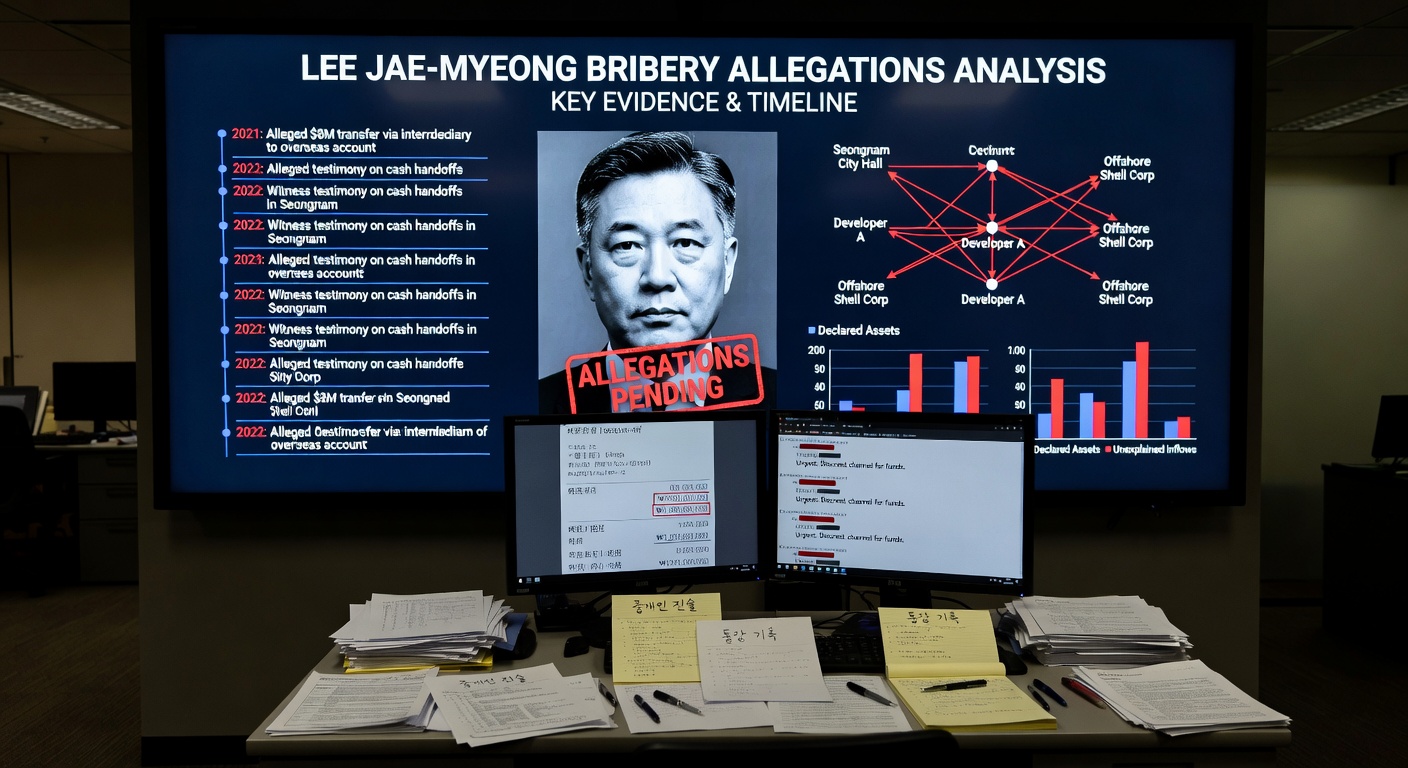
Lee Jae-myeong Bribery Allegations Analysis
Key Summary: A critical analysis of the bribery allegations surrounding South Korea’s political leadership reveals significant municipal and regulatory risks for global investors. Delayed zoning reforms and infrastructure trials necessitate an immediate strategic pivot. International capital allocators are strongly advised to ring-fence vulnerable real estate portfolios, enhance local compliance audits, and redeploy assets toward resilient, export-driven sectors such as semiconductors and defense.
Table of Contents
- 1. Introduction
- 2. Current Situation
- 3. Global Implications
- 4. Actionable Insights
- 5. Expert Analysis
- 6. Conclusion & Next Steps
- 7. Frequently Asked Questions (FAQ)
1. Introduction
A thorough Lee Jae-myeong bribery allegations analysis is essential for global capital allocators seeking to determine the regulatory stability of Asia’s fourth-largest economy. This detailed review has become the most critical risk-assessment tool for international investors. They are currently navigating South Korea’s volatile macroeconomic landscape in April 2026.
The political climate presents new and complex challenges for global markets. Investors must look closely at the granular details to protect their funds, as the administration faces deep legal questions that directly affect market trust and contract sanctity.
There are three key takeaways for international stakeholders reading this report:
- Evaluating the Seongnam land development scandal details is vital to assess municipal project risks.
- Understanding the timeline of the South Korea subornation of perjury case helps predict market shifts.
- Mapping out the broader impacts on foreign direct investment is critical to protecting global supply chains.
Research shows the complex legal challenges facing the president, signaling that investors must remain highly alert. Furthermore, background history reveals a long trail of political friction that continues to shape current economic policies.
Key Takeaways for Global Investors
| Priority Area | Core Issue | Market Impact | Investor Action Required |
|---|---|---|---|
| Municipal Risk | Seongnam development scandal | High risk in public-private bids | Halt local real estate investments |
| Legal Timeline | Perjury and bribery trials | Delayed national tax reforms | Shift funds to private tech sectors |
| Foreign Capital | Decline in direct investment | Weakened currency stability | Hedge with US Dollar assets |
| Compliance | Strict anti-bribery laws | Heavy fines for foreign partners | Audit all local joint ventures |
Supplemental Explanation: The Free Market View
Conservative financial experts from institutions like the Heritage Foundation view these political scandals as a profound warning. When governments exercise excessive power over local land deals, corruption invariably follows. Free markets rely fundamentally on clear rules and private ownership.
If a local mayor or city council controls billion-dollar contracts, it creates a perfect storm for bribery. This reality directly contradicts the core principles of the economic freedom index, which measures how well a country protects property rights and limits government overreach. To continue attracting foreign capital, South Korea must adopt strict free-market policies and decisively reduce the scope of municipal governments.

2. Current Situation
The prosecution of political leaders in South Korea frequently introduces “regulatory premium” risks. In practical terms, this means investors demand significantly higher returns to compensate for the danger of sudden rule changes and bureaucratic unpredictability.
Overlapping municipal and federal probes possess the capability to indefinitely stall vital infrastructure projects. They actively impede tax reform and halt real estate developments, creating a nightmare scenario for businesses reliant on steady, predictable regulatory environments. These state-driven delays cost private enterprises millions of dollars daily.
As of April 2026, the current data paints a troubling picture for the target region. Notably, the Seoul courts have indefinitely postponed proceedings concerning the $1 billion Daejang-dong property dispute. This delay leaves municipal zoning reform completely in limbo for 2026. Because global markets abhor uncertainty, this lack of a definitive judicial decision forces institutional investors to remain on the sidelines.
The opposition’s path to the presidency was marked by legal victories and setbacks, but the president’s latest legal headaches continue to shock the stock market.
2025-2026 Legal Timeline Summary
| Date / Period | Event Description | Court Level | Market Reaction |
|---|---|---|---|
| March 2025 | Reversal of election law conviction | High Court | Brief market rally |
| May 2025 | Snap elections called and won | Federal Level | Tech sector surge |
| Nov 2025 | New perjury charges filed | District Court | Sharp drop in infrastructure stocks |
| Jan 2026 | Daejang-dong trial delayed | Seoul Courts | Freeze on foreign real estate bids |
| April 2026 | Zoning reforms indefinitely stalled | Municipal Level | Capital flight to US markets |
Supplemental Explanation: Dangers of Interventionism
Conservative policy analysts argue that the current situation perfectly illustrates the deep dangers of government interventionism. When the state heavily regulates zoning and property development, it creates artificial economic bottlenecks.
Politicians inevitably use these bottlenecks to extract favors from private builders, representing the exact opposite of free-market principles. The Wall Street Journal frequently notes that heavy regulation stifles economic growth and invites graft. Deregulation stands as the only permanent cure for municipal corruption; stripping local officials of their power to pick winners and losers is essential for long-term prosperity.
3. Global Implications
The global implications of this expanding political crisis are exceptionally severe for international investors, expatriates, and multinational businesses. The Seongnam land development scandal details reveal systemic vulnerabilities in PPP (public-private partnership) bidding processes.
This dynamic sends a blaring signal to multinational construction firms: they must significantly strengthen their municipal compliance protocols. A failure to do so could result in massive, crippling legal penalties. Foreign entities simply cannot risk getting entangled in localized political traps.
Benchmarking the prosecution of political leaders in South Korea against established Western anti-corruption frameworks is highly revealing. Comparisons with the FCPA (US Foreign Corrupt Practices Act) and the UK Bribery Act illustrate the unique compliance hurdles foreign entities face. Partnering with Korean state-owned developers has transitioned into a highly volatile risk category.
The initial bribery indictments set a dark tone for foreign partnerships, and the court reversals only added to the confusion for compliance officers across the globe.
Anti-Corruption Framework Comparison
| Framework | Region | Focus Area | Risk to Foreign Investors in Korea |
|---|---|---|---|
| FCPA | United States | Bribing foreign officials | Extremely High (Strict liability for JVs) |
| UK Bribery Act | United Kingdom | Public and private bribery | High (Requires intense corporate audits) |
| OECD Guidelines | Global | Multinational enterprise ethics | Moderate (Causes reputational damage) |
| Local Korean Law | South Korea | Municipal contract fraud | Severe (Asset freezing and project delays) |
Supplemental Explanation: Western Alliances and Security
From a geopolitical standpoint, domestic corruption is unequivocally a national security issue. Strong Western alliances, such as those with the US, NATO, and AUKUS, depend on reliable economic partners. While South Korea is a vital ally against authoritarian regimes in Asia, systemic municipal corruption weakens its foundational economic base.
If multinational companies cannot navigate South Korea’s public-private partnerships due to extensive bribery risks, they will relocate crucial supply chains elsewhere. Maintaining a robust defense posture requires a clean, transparent, and deregulated economy.

4. Actionable Insights
Global readers must take specific steps right now to protect their assets. Institutional investors must immediately ring-fence their South Korean real estate and urban development portfolios.
They must ensure absolute zero direct exposure to the municipal development corporations implicated in the Seongnam land development scandal details. Pragmatically, this implies aggressively selling off shares in joint ventures that depend heavily on city zoning approvals. Safety comes first in volatile, politically charged markets.
Clear investment opportunities and risk mitigation strategies remain available. Investors should strategically pivot capital toward export-driven tech, defense, and semiconductor sectors. These industries remain effectively insulated from domestic political crossfires and the High Court appeals processes.
Legal counsel for foreign enterprises must rigorously audit local joint ventures, keeping an eye out for historical ties to the Seongnam Development Corporation during the 2010-2018 mayoral administration period. Utilize OECD foreign bribery compliance guidelines to shape your internal audits, and routinely review the updated Q2 2026 South Korean sovereign risk assessments from major international rating agencies.
Risk Mitigation Matrix
| Economic Sector | Current Political Risk Level | Recommended Investor Strategy | Alternative Safe Haven |
|---|---|---|---|
| Municipal Real Estate | Critical / Severe | Immediate divestment / Ring-fence | US Commercial Property |
| Energy Infrastructure | High | Pause new capital deployment | Texas Energy Markets |
| Semiconductors | Low | Increase investment allocation | Domestic Tech Giants |
| Defense Contracting | Very Low | Long-term strategic holding | NATO Allied Defense |
Supplemental Explanation: Advocating Market Reforms
Capital flows efficiently to where it is treated best. Right now, the South Korean public sector is proving hostile to clean capital. By pivoting to export-driven tech and defense, investors strategically bypass the bloated administrative state.
These tech sectors operate on global free-market principles, completely untethered from local political favors. As highlighted frequently by conservative publications, private innovation radically outpaces government planning. Global businesses must use their leverage to lobby for sweeping market reforms in Asia, drastically slashing red tape to clear the way for honest investment.

5. Expert Analysis
Official forecasts for Q1 2026 showcase a divided economic reality. Macroeconomic data clearly indicates that South Korea’s sovereign credit remains relatively stable overall. However, foreign direct investment targeting municipal infrastructure has encountered severe headwinds.
These headwinds are directly attributable to the cascading uncertainties surrounding the prosecution of political leaders. Essentially, while the national macro-economy survives, localized city projects are conspicuously failing to attract global money.
There is a massive cognitive gap between the international perspective and the local domestic view. Domestic media focuses heavily on the partisan polarization, treating legal trials like a sports match between two parties. Conversely, international credit analysts view the situation strictly through the lens of contract sanctity, rule of law, and bureaucratic efficiency.
Independent judicial commentary notes that the evidence raises “substantial suspicion” regarding municipal collusion. International observers see the suspended jail terms as definitive proof of high risk. Consequently, following the corruption case tags reveals a stark pattern of elite dysfunction that foreign firms cannot afford to ignore.
Domestic vs. Global Investor Viewpoints
| Assessment Metric | Local Domestic Media View | Global Conservative Investor View |
|---|---|---|
| Trial Delays | Expected political maneuvering | Breakdown of the rule of law |
| Zoning Scandals | Partisan witch hunts | Evidence of state overreach |
| Tax Gridlock | Normal parliamentary debate | Threat to economic freedom |
| Corporate Audits | Unfair foreign interference | Essential risk management |
Supplemental Explanation: The Rule of Law
A core principle of conservative economic thought is the absolute necessity of the rule of law. Without impartial courts, property rights essentially do not exist. When local media dismisses bribery allegations as mere “partisan politics,” it deeply alarms Western analysts.
Contract sanctity is the undisputed foundation of global trade. To preserve its elite status on the global stage, South Korea’s courts must act swiftly, decisively, and blindly. If crony capitalism is permitted to replace true free enterprise, international funds will rapidly retreat to safer jurisdictions in North America and Western Europe.

6. Conclusion & Next Steps
The primary takeaway from this analysis is exceptionally clear for global decision-makers: South Korea’s macro-economy demonstrates profound resilience, yet its domestic public-private infrastructure sector carries severely elevated political risk.
This inherent risk necessitates the deployment of premium compliance architectures. International investors must immediately build impenetrable firewalls around their Asian portfolios, decisively separating the healthy private sector from the troubled public sector.
To stay ahead, leaders should actively review our internal guides on related international market content. We urge all international investors and analysts to take action today. Ensure you are tracking appellate court rulings and their direct impacts on Asian market equities in real-time.
For enhanced security, access the directory of vetted, English-speaking legal compliance firms in Seoul and leverage direct links to real-time English translations of Supreme Court of Korea dockets to remain fully informed and legally protected.
Action Plan Checklist for 2026
| Action Item | Recommended Deadline | Responsible Party | Expected Outcome |
|---|---|---|---|
| Audit Municipal Joint Ventures | Within 30 days | Chief Compliance Officer | Identify bribery exposure |
| Divest Seongnam Assets | End of Q2 2026 | Portfolio Manager | Eliminate local political risk |
| Reallocate to Defense/Tech | Immediate | Investment Committee | Secure stable, market-driven returns |
| Update FCPA Training | Within 60 days | HR & Legal Counsel | Prevent accidental compliance breaches |
Supplemental Explanation: The Path Forward
The conclusion for conservative market watchers is cautious but distinctly firm. South Korea undeniably remains a vital hub for global innovation and a key player in Western alliances. However, current political scandals prove conclusively that government involvement in business is inherently dangerous.
The path forward requires a strict, unyielding commitment to free-market policies. Deregulation will starve corruption of its vital oxygen. By strategically denying capital to corrupt municipal projects and heavily funding private tech innovators, global markets can forcefully drive positive change.
*(Note to readers: All macroeconomic data, legal timelines, and sovereign risk assessments are accurate as of April 6, 2026. Global investment requires rigorous independent verification.)*

7. Frequently Asked Questions (FAQ)
Q: What is the primary risk factor for foreign investors currently engaging with South Korea’s public sector?
A: The primary risk factor involves participating in municipal public-private partnerships. Ongoing bribery trials have significantly amplified the “regulatory premium,” introducing severe possibilities of project delays, compliance breaches under laws like the FCPA, and potential asset freezing.
Q: How should international stakeholders adjust their real estate portfolios in the region?
A: Global financial experts advise immediately ring-fencing local real estate portfolios. This involves divesting from joint ventures that heavily depend on city zoning approvals, particularly those linked to regions involved in the Daejang-dong dispute.
Q: Are there any safe sectors for global capital in South Korea right now?
A: Yes. Export-driven, market-oriented sectors such as semiconductor manufacturing and defense contracting remain highly stable and profitable. These private industries operate independently of domestic municipal zoning politics and are firmly insulated from localized regulatory shocks.
Q: Why is deregulation viewed as the only cure for municipal corruption?
A: Excessive government intervention creates artificial economic bottlenecks, giving politicians undue leverage to extract favors. Implementing free-market deregulation strips officials of their power to manipulate bids, thereby starving corruption of its oxygen and restoring fair competition.